Monday, November 2, 2015

The Colonel and The Colonel and The Colonel's Restaurant


The Colonel has a history with The Colonel...Colonel Sanders that is. He worked at a Kentucky Fried Chicken restaurant for two years while in high school. He was a fry-cook.


The Colonel used to wear a Caduceus pin on his uniform to inform everyone that he was a "Doctor of Fryology".


WNAP, a classic/album rock radio station in Indianapolis, Indiana held a raft race down the White River for nine years (1974-1983). In 1982, The Colonel and co-workers talked their boss into allowing them to build a raft and join the race. His boss not only said sure, but also funded the majority of the project.

The 8'x8' raft was constructed at The Colonel's house and my (future) Favorite-Father-In-Law helped (wild horses could not have dragged him away from the project). The raft was made in the image of a KFC meal box.


The Colonel, his father and a couple of co-workers paddled, or swam next to the raft for the entire four mile race.

At the height of the WNAP Raft Race it is reported that there were around 1,400 rafts floating down the White River and at least 100,000 people waiting at the race's egress point, Broad Ripple Park, listening to live music.

The Colonel says that he is surprised that he did not contract a disease while swimming in the White River back then.

So, now back to more recent times...The Colonel and I had just left Fort Boonesborough and it was near lunchtime. My pre-trip planning had us making a stop in North Corbin, Kentucky. There we pulled into the parking lot of Sanders Cafe, aka the original KFC.


Inside the cafe there was also a museum. The Colonel and I walked in, ordered our lunch at the counter and then found a table that overlooked the original kitchen where Colonel Sanders created and perfected his world famous, "finger-lickin-good" chicken.


This was Colonel Sanders' office.


There were glass cases filled with all kinds of KFC and Sanders memorabilia.


A display containing original furniture and dishes from the early days of the cafe were behind glass.


Colonel Harland Sanders not only ran a cafe but he also ran his own motor court next door. The diorama below shows what the cafe and motor court looked like in their day. The court is no longer there.


Inside the cafe/museum was a mock-up of what the rooms used to look like. Colonel Sanders always prided himself on the cleanliness of his rooms.


Colonel Sanders had a very interesting life before he became famous for his chicken at the age of 65.


He was a lawyer, midwife, tire salesman and more...visit these two links to learn more about Harland Sanders.


Colonel Sanders and I share the same birthday and we were both born in Indiana (he didn't like math either). I always knew there were other reasons why I liked him and his chicken.


Last summer The Colonel and I passed through Louisville, Kentucky and we stopped at Cave Hill Cemetery. It is a large and beautiful cemetery and it is where Colonel Harland Sanders is buried. We wanted to stop and pay our respects to the founder of KFC. 


Colonel Sanders died in 1980. He said, "I never had the desire to be the richest man in the cemetery". Before his death he gave millions of dollars to many charities, schools and hospitals.

The Colonel and I joke that we can never visit another KFC restaurant now, because we have been to the original...come to think of it, as of the writing of this post, we have not been to another KFC since June. 

Sunday, November 1, 2015

Annual Assignments


What We Did on Our Summer Vacation 2015
By Bird

It was an annual task,
As children, teachers would tell us to write when they'd ask,
“What did you do this summer?”
One as adults, we seldom now record, what a bummer.

The Colonel and I visited “Hoosier land” to see my Mum,
He and I stopped at our Alma Maters and then some.
We saw Gabriel’s footprint in New Harmony,
Lincoln’s boyhood home and the grave of his mommy.

A brief stop in Corydon, Indiana’s first capital,
Then to Kentucky and the gravesites of the Boones, Rebecca and Daniel.
Near the Boone graves and quite in view,
Was buried the founder of Punta Gorda, Isaac Trabue.

We visited the site of the last battle of the American Revolution, at Blue Licks,
Where Boone’s son, Israel and others had fallen and I picked up some ticks.
Then The Colonel and I explored a very old cemetery and lunched at Lil’s café,
A stop at Boone Station and Boonesborough State Park rounded out the day.

Next morning up early we see,
A Fort Boonesborough facsimile.
We see a spinner, a potter and homemade soap by the bar,
A man who can make fire with flint, tow and char.

It is time to leave Fort Boonesborough behind,
We are getting hungry, it is lunch we must find.
It is off to Colonel Harland Sanders’ café and museum for food,
The original KFC, our lunch was “finger-lickin’-good”.

Our time in Kentucky is winding down,
Just a few more places to visit before we head back to our home town.
The first log cabin in Kentucky, for Dr. Thomas Walker a boon,
And a trek along the Cumberland Gap following the footsteps of thousands and Boone.

Kentucky behind us and Georgia next in our sites,
To visit its state cotton museum and “Good to Go” bar-b-que sandwiches for bites.
The museum and lunch spot were located in Vienna,
But please do not mispronounce, it is said like…Vie-enna.

So that is what we did on our summer vacation away from Florida,
We had much fun and made many memories, but it’s good to be back in Punta Gorda. 

Wednesday, October 28, 2015

Saturday, October 24, 2015

Fort Boonesborough Facsimile


The Colonel and I could not wait to visit the Fort Boonesborough facsimile. We were among the first visitors at the fort's open gates.


As we paid for our tickets, we were told that a couple school buses were due to arrive within the half hour. The Colonel and I thanked the ticket seller for the heads-up and quickly entered the fort and began our tour. We wanted to see as much as we could sans schoolkids.

In a previous post, I wrote a little about the history of Fort Boonesborough. All that remains is a granite marker that bears the names of the settlers and marks the location of the fort. This facsimile of Fort Boonesborough was built here, above to original fort site and out of the flood plain of the Kentucky River. I will not go into the history of the fort here. This post is about experiencing what the original fort would have looked like and what life would have been like for the early settlers of Kentucky.

This is a drawing of the original Fort Boonesborough:


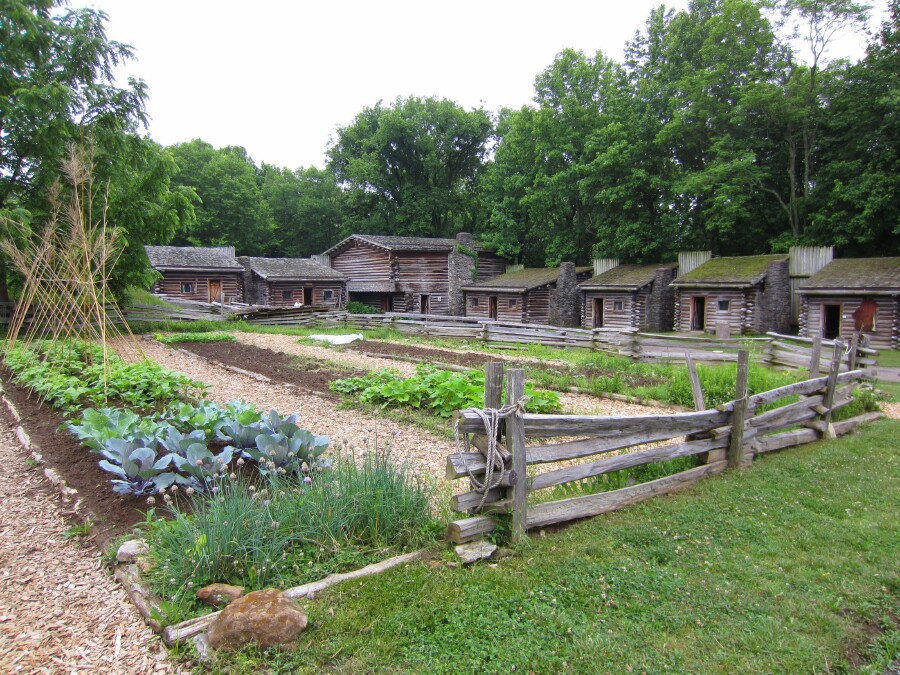
This is what the Colonel and I saw when we first entered the facsimile fort:


We saw a man in a felt hat who showed us how the early settlers started a fire with flint and metal.


He took the C-shaped piece of metal and struck it against some flint. The flint had a bit of char on top of it. A tiny spark was created when he struck metal to flint and that spark landed on the char. He put the spark-laden char on some tow.


He gently blew on the tiny spark that was nestled upon the tow material and flames jumped out immediately.


The Colonel and I were so impressed that we purchased a metal striker, flint, char and tow from the gift shop before we left and tried it at home. We made fire...just not as quickly as the man above.

There was a short video that was shown in one of the corner block houses. It was about Fort Boonesborough, Daniel Boone and the Kentucky Wilderness. Well, done and very informative.

After watching the video The Colonel and I began our self-guided tour of the fort in earnest (remember, busloads of school kids were hot on our trail).

The first cabin we looked into was representative of what pioneers would expect to live in when they arrived at the fort (dirt floor, no off-the-floor bed). The next two cabins showed improvements. The cabins' comfort levels increased over time as the early settlers made or bought furniture and other household goods.


As The Colonel and I walked around the fort we stopped inside other cabins where we saw artisans at work. We saw a spinner, potter, soap maker and candle maker.


We looked into the tavern/store. I could just see Cincinnatus from the Daniel Boone television show serving up some whiskey to a weary traveler.


We saw a painting in one of the blockhouses that showed what Fort Boonesborough would have looked like in the Kentucky wilderness. It was a nice painting.


It was even nicer to be able to walk through a replica of Fort Boonesborough and imagine what Daniel Boone lived like and all those who came into Kentucky after him.


Our tour of Fort Boonesborough was coming to a close and it was now time to say farewell to this leg of our trip. Our next stop in Kentucky would be at a famous restaurant for a finger-lickin' good lunch.